Swarms
In summer we get many calls and questions from members of the public with bees in their houses, outbuildings and gardens but our volunteer members are only able to help in cases of swarms of honey bees.
Bees swarm as a natural process of reproduction, driven by a growing colony needing more space. When a hive becomes too crowded, the colony raises new queens, and the old queen leaves with a large portion of the worker bees to establish a new colony. Before leaving, the swarm gorges on honey for energy, making them typically docile as they search for a new home.
If you have a swarm that you would like to report for someone to collect, there are numerous people who are experienced in collecting these within our area. Many of whom are members of Hastings and Rother Bee Association.
It is important to identify the bees as honey bees and not wasps or hornets. Those who are collecting these bees are most likely to collect the bees for free as they’re able to home the bees with members waiting on bees or to be kept to produce lovely honey. As they’re giving up their time to collect the bees it is important to recognise honey bees over other insects to avoid everyone’s time being wasted.
Keep children and pets inside or away from the swarm and out of the way of the bees. Those without protective clothing are at risk of stings and further complications.
To identify a honey bee swarm, look for a dense, brown or golden-brown cluster of insects—often about the size of a football or basketball—hanging from a structure like a tree branch, fence, or even a vehicle. Unlike established nests, a swarm is a temporary stop where bees are simply resting while scout bees search for a permanent home. Use our Identify Page or the BBKA Identify page to determine they are indeed honey bees.
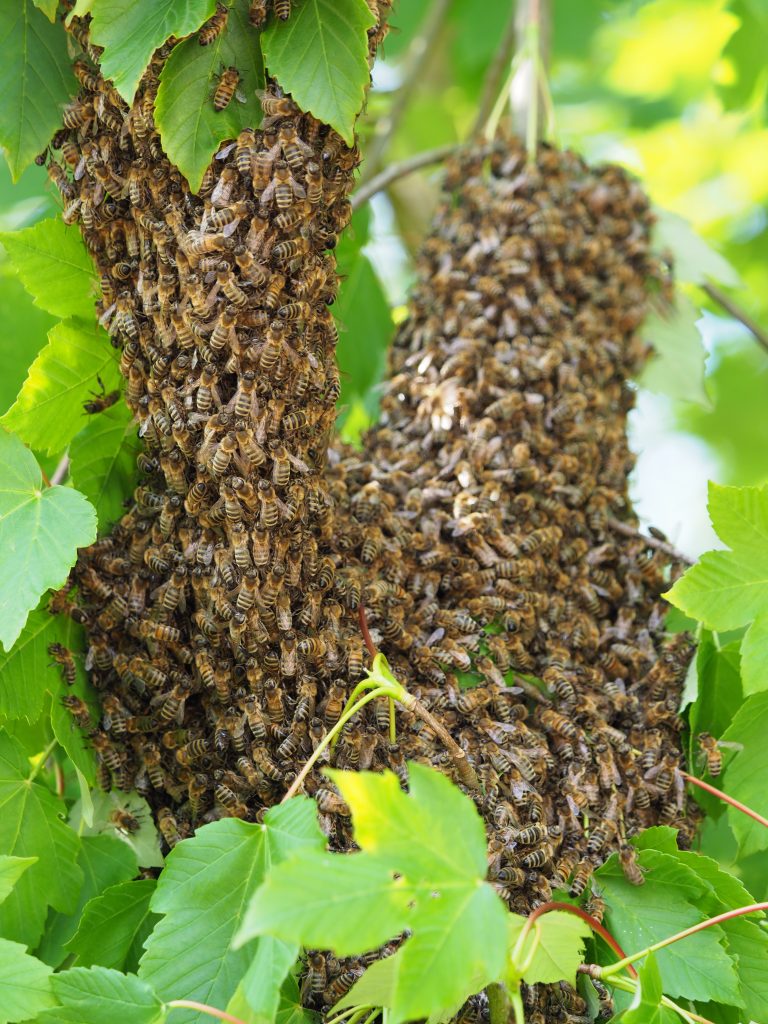


While honey bees are generally at their most docile during swarming (as they have no honey or brood to defend), you must approach with extreme caution. A swarm can become defensive if physically disturbed, sprayed with water, or subjected to loud vibrations from machinery like lawnmowers. Maintain a safe distance of at least 10 meters (approx. 30 feet) and avoid sudden movements or dark, furry clothing that might resemble a natural predator. It is critical to distinguish them from wasps, which are bright yellow with distinct black stripes and smooth bodies, or bumblebees, which are much rounder and fuzzier. If the insects are entering a single hole in a wall or roof, they are likely an established colony rather than a swarm, and you should never attempt to seal the hole or remove them yourself.
Safety Checklist:
- Keep your distance: Do not stand directly under or next to the cluster.
- Keep pets and children away: Ensure they do not throw objects at the swarm.
- Identify correctly: Check for duller, amber-brown banding and hairy bodies.
- Do not use chemicals: Never spray a swarm with insecticide; this agitates the bees and makes professional collection much more dangerous.
- Call a professional: Use the British Beekeepers Association (BBKA) swarm map to find a local collector who has the training and protective gear to relocate them safely. Please only arrange collection with one beekeeper. You may need to contact more than one to find someone who is able to collect.
When You Report a Swarm
When you call HRBKA to report a swarm, our volunteer beekeepers act as “detectives.” They need to ensure they are fully prepared and that the insects are definitely honey bees.
Phase 1: The “Interview”
Beekeepers are volunteers who often travel at their own expense. To avoid “wasted journeys” for wasps or bumblebees, they will ask the following:
-
“Can you describe the cluster and its size?” — Honey bees cluster in a ball, often compared to the size of a football.
-
“How high is the swarm?” — This tells the beekeeper if they need a ladder, a long-reach pole, or a second person for safety.
-
“Where exactly is it located?” — A flexible tree branch is easy; inside a chimney or roof is usually impossible for a standard volunteer.
-
“How long have they been there?” — Bees that have stayed for days may have started building comb, making removal more complex.
-
“Are you 100% sure they are honey bees?” — Most calls are actually for Bumblebees (in bird boxes) or Wasps (in holes). Beekeepers only collect honey bees.
-
“Can you send me a photo?” — This is the most important step. A clear photo saves everyone time.
Phase 2: What to Expect During the Visit
If a beekeeper agrees to attend, the collection is usually a two-part process that takes several hours.
Step 1: The Capture (Daytime)
-
Arrival: The beekeeper will arrive in a white suit and veil. Please keep children and pets indoors and close all windows.
-
The “Shake”: If the bees are on a branch, the beekeeper will place a box or straw “skep” underneath and give the branch a firm, sharp shake to drop the bees inside.
-
The Waiting Game: The box is placed on the ground (often on a white sheet) with one edge propped up.
-
Finding the Queen: If the Queen is in the box, the others will begin “fanning” (tails in the air) to guide the colony inside.
Step 2: The “Settling” Period
-
Leaving the box: The beekeeper cannot take the bees away immediately. The box must remain in place until dusk.
-
Why wait? Thousands of “scout bees” are currently out flying. We must wait for these “commuters” to return home for the night so they aren’t left behind.
Step 3: The Departure (Evening)
-
Collection: The beekeeper returns at sunset when all bees are tucked safely inside.
-
Sealing: The box is wrapped in a secure mesh or sheet and taken to a quarantine apiary for health checks.
A Note on Costs
Our members collect swarms voluntarily. Some beekeepers may ask for a small contribution toward fuel costs, which should be made clear before they arrive. Most collect for free to increase their stock or to help a new HRBKA member begin their beekeeping journey.